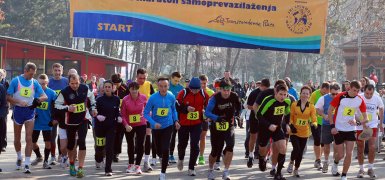
 |
| The Sherbrooke Forest, Dandenong Ranges Running Trails submitted by Kishore Cunningham Distance: Various choices, Terrain: Undulating trails Highlights: Rainforest, Cafe's for post run Devonshire Tea. |
|
Two of Australia's most famous distance running sons, Ron Clarke and Rob (Deek) de Castella have immortalised this amazing set of running trails in beautiful temperate rainforest just an hour's drive from Melbourne. Back in the '70s and '80s you could join packs of up to a hundred runners, all members of Melbourne's club running fraternity and doing their obligatory "long run" for the week. Each pack would have a favoured route through the forest; each would know when to apply the pressure to test the legs, hearts and lungs of even the hardiest of runners.
Then there's "Areoplane Hill", a short, sharp almost vertical incline that leaves you gasping for air when you get to the top. But if you run down it instead of up, you could just about become airborne! I guess that's where the tag comes from. |
Featured stories from around the world
 These days I seldom get the chance to run "Ferny", but when I do, the memories come flooding back.
2 weeks prior to a race:
· Avoid caffeine, diet sodas and alcohol.
· Maintain an adequate balance of electrolytes by taking in sports drinks as well as plain water for hydration.
· Increase fluid intake. Be sure that your urine is a light yellow.
· Slightly increase carbohydrates. Maintain a 60% carbohydrate / 40% protein ratio. Don't worry about a depletion / loading cycle.
· Don't try anything new in terms of diet or fluid intake.
· Be well rested. Getting a good night's sleep two nights before the race is more important than the night before the race.
Morning Of The Race
· Have your last meal 3 hours prior to the start: 75 - 100 grams of carbohydrates (complex carbohydrates / maltodextrins).
· Drink 10 - 12 ounces of fluid each hour during the 2 - 3 hours before your race, up to 30 minutes prior to the start.
Race / Workout - Fueling & Nutrition
· 15 minutes after you start, begin fueling. This helps your blood sugar and insulin levels adjust to your exercise.
· Maintain fluid intake throughout the race. Your body can absorb no more than 28 oz. / hour. Remember it's critical to supplement with electrolytes to avoid hyponatermia.
· Your body can absorb up to a maximum of 240 - 280 carbohydrate calories / hour into the energy cycle.
· Carbohydrates / complex sugars such as Maltodextrin (18 - 24% solution) are preferred because more calories pass into the blood faster than with simple sugars (6 - 8% solution). Studies have shown that simple sugars result in blood sugar levels below even fasting levels.
· For events longer than 1 hour, supplement with protein along with carbohydrates. Use a 1:4 ratio (p:c) to increase energy levels, and decrease muscle breakdown.
· Continue to supplement electrolytes, especially during hot and or humid weather. You should use a buffered electrolyte supplement containing sodium, potassium and magnesium.
Post-Workout / Race Nutrition
· Immediately begin to replenish fluids.
· Within 30 minutes of finishing, consume 10-20 grams of protein.
· Within 30 minutes of finishing, consume 250-350 calories of carbohydrates (or more). Research has shown there's a 2-hour window during which your body will absorb the protein and carbohydrates lost during exercise. The first 30 minutes of this window are the most critical. Your body will absorb 100% of the carbohydrates and proteins it needs during the first 30 minutes. The level of absorption decreases as the 2-hour window progresses.
Chill Out In An Ice Bath
Take an ice bath - from your hips down - after every hard workout, long run or race. This will reduce intra-muscular fluids and swelling and close down capillaries. It also reduces post-exercise soreness and eliminates delayed onset muscle soreness (DOMS). Fill the bathtub with enough water to cover you up to your naval, then dump in enough ice cubes to cover the bottom of the tub. Sit in the ice cold water for 10 minutes. Initially the shock of sitting in the cold water will take your breath away, but within a few minutes you'll become numb to the cold.
Training for and participating in an ultra-marathon can be an immensely satisfying experience that will give you a tremendous sense of accomplishment. If you trained adequately, maintained good nutritional habits and were physically and mentally prepared, your first ultra will be the precursor to many more!
The keys to successfully preparing for your first ultra-marathon are:
1. Long Runs. Time on your feet. You need to adapt to spending long periods of time on your feet and moving forward. Longer runs (>4 hrs.) can be broken up with walking breaks. In fact, learning to walk and then run again is a key to success in ultra-marathons.
2. Hills! Hills! Hills! Whether your goal race is hilly or not, the more hills you do in training, the stronger you'll be and the better prepared for your ultra.
3. Middle Distance Workout. The weekend run on weeks you don't do a long run (distance weeks) is very important. If the run is around 15 miles, you'll get an excellent workout, and you'll recover quickly from it. You can run this distance as a tempo run.
4. Your Training Speed Will Be Your Racing Speed. Don't let your long runs drag on for hours. Keep your pace up. When doing your long runs, don't let your pace slow down to a shuffle.
You build muscle during the Strength Building phase. During this phase you increase the number of muscle fibers in your leg muscles, as well as the mitochondria and enzymes needed to breakdown lactates during exercise. The Strength Building phase focuses on your ability to produce energy. It also raises your lactate threshold. Workouts during this phase are characterized by hills - hill running and hill drills. Getting stronger is your goal during this time. The Strength Building phase should last about 8 weeks.
If your ultra is on a very hilly course, you may want to increase the number of weeks in this phase to 12. If you're an experienced runner (if you've been running for over 3 years without injury, or have completed 3 marathons), start doing hills (strength building) in the second half of the Base phase. Do one hill workout per week after the first 2 weeks of the Base Building phase. You can do up to two hill workouts per week during the Base Building phase, but don't do a second hill workout if you're running a race that weekend.
In 1979 I had the opportunity to meet with Arthur Lydiard. During our conversation he emphasized the importance of hill training. Lydiard had all his athletes, from marathoners like Barry Magee, 5,000m runner Murray Halberg, to 800m runners like Peter Snell, run hills during both the Base Building and Strength Building phases of their training. Don't increase your weekly mileage during the Strength Building phase, and the length of your long run should remain constant through this phase. Increase the number of hill workouts you do each week, as well as the number of hill repeats you do each session. Don't do more than 3 hill workouts per week and no more than 12 hill repeats per workout.
You can race during the Strength Building phase. If you choose to race, reduce the number of hill workouts by one during race week. You shouldn't require time off, either before or after a race during the Strength Building phase.
Lactate Threshold Workouts
Hill training is an excellent form of a lactate threshold (LT) workout. The purpose of this workout is to build muscles, develop extra capillaries and improve the energy production system in your muscles. It's designed to raise your heart rate up to 95% for at least 2 minutes at a time, then allow your heart rate to drop down between the hard efforts. Start with four 2-minute hard efforts and increase that number each week. Running hills is the best way to raise your heart rate. Don't worry about speed during these hard efforts.
Hill Training
Hill training consists of hill running and hill drills. Hill Training isn't as hard on your body (specifically your legs) since running uphill is less jarring. Research has shown that periods of near maximum heart rate effort for 2-6 minutes produce optimal gains, and hill training produces significant gains in four key measures:
· Improved running economy.
· Increased VO2 max.
· Improved vVO2 max (running speed at VO2max)
· Increased lactate threshold (the ability of muscles to clear lactate from blood)
Hill Running:
Find a hill that's reasonably steep - around 6% grade is perfect. It should take you at least 2 minutes to run up the hill. Focus on your body position going up the hill and going down the hill. On the way up: shorten your stride slightly, increase your knee lift and arm action, and run up on your toes - getting a good push from your hips, knees and especially your ankles and toes. On the way down the hill: lengthen your stride slightly by increasing your follow-through (high foot in the back of your stride; drop your hands so they're near your hips / waist; lean down the hill; focus on landing on the midfoot or forefoot, not on your heel (which will cause a braking action and tremendously increase the impact as you run down the hill.)
Run the hill emphasizing lift off the ground. It's not as important to run fast up the hills as it is to run with good form and a powerful stride. Your heart rate should be at or near maximum when you reach the top of the hill.
After running up the hill, turn around and run down the hill. This is your recovery period, so run relaxed and allow your legs to stretch out. Allow gravity to carry you down the hill, don't accelerate when running down the hill - remember this is your recovery.
Hill Drills:
Hill drills are done at a slow pace. The goal is to get lift off the ground and not to move forward at a rapid pace. Your progress up the hill should be slow. It should take up to 6 minutes to reach the top of the hill. All drills should be performed SLOWLY!
Bounding: Elongate your stride and emphasize arm action. Focus on getting off the ground. Think of jumping over puddles with a long stride.
Skipping: Skip slowly up the hill, emphasizing knee lift and arm action. Focus on getting high off the ground.
Springing: Emphasize knee lift and getting high up off the ground. Don't emphasize forward movement. Think of jumping over logs.
The Strength Building phase should last for at least 6 weeks, but no more than 12 weeks.
Goals of The Strength Building Phase:
Build muscular strength.
· Increase capillary beds.
· Build mitochondria.
· Improve lactate enzyme response.
· Raise lactate threshold.
· Maintain aerobic fitness.
· Maintain and increase VO2max.
· Maintain cardiovascular and muscular endurance.
· Maintain base mileage and distance of long workouts.
Only experienced ultra-marathoners should try a Speed Building phase. Even experienced ultra-marathoners that aren't attempting to "race" an ultra-marathon, including those that are looking to improve their time, would do well to skip the Speed building phase.
If you do use this phase, maintain your long runs, reduce your weekly mileage slightly and add time trials and races as speed work.
Conventional speed work is inappropriate for ultra-marathoners. Instead, on weeks you don't do a long run, run a race - 10K or longer - or do a time trial - again, 10K or longer. Your longest race or time trial, will depend on two factors. First is your ability to run a race at less than maximum effort. If you're capable of racing at 85-90% of maximum effort, races will help you. If you do them at a greater effort, they'll hurt you by limiting your ability to train after the race. The second factor is your ability to recover after a hard effort. If you need 2 or 3 days off after a race, don't race. You'll lose too much training time, and jeopardize your ultra marathon. To speed up your recovery and stay on the road after your hard efforts, pay close attention to NUTRITION AND FUELING.
During Base Building you develop cardiovascular and pulmonary function. This phase focuses on improving your ability to transport oxygen. The workouts during this phase are characterized by increasing the amount of time / distance you're running. Gradually increase your weekly mileage, and increase the distance of your long run. This phase should be the longest of your training. It should last at least 12 weeks and possibly up to 16 weeks.
The Base Building phase is all about building aerobic fitness. Run the same weekly mileage for at least 2 weeks before increasing your mileage. Only advanced runners should do a long run every week. All others should do one long run every 2 or 3 weeks.
You shouldn't race during the Base Building phase. If you choose to race, your effort shouldn't exceed 85% of maximum heart rate. You shouldn't take time off, either before or after a race during the Base Building phase.
Work in 4-week cycles. Week 1 is your "base" week. In week 2 increase your weekly mileage by about 10%. In week 3 increase the distance of your long run, but keep the total weekly mileage the same as week 2. Week 4 is your recovery week - return to "base" week mileage.
This plan gives you 4 long runs, from 20 to 30 miles during a 16- week period, which will prepare you to finish your first ultra marathon. If you're an experienced marathoner, you may increase that number by adding a long run on your "mileage" week - increase the long run that week to the same distance as your "long" week.
Very experienced runners may also add a back-to-back long weekend. Run a long run on Saturday and another long run on Sunday. (Don't attempt this unless you're an experienced runner who has finished many marathons.)
Goals Of The Base Building Phase:
· Build cardiovascular and muscular endurance.
· Increase aerobic fitness.
· Increase weekly mileage.
· Increase length of long run.
· Improve VO2 max.
By Neil L. Cook, BS, MS, Med
Just about anyone can finish a marathon. Finishing an ultra-marathon isn't as certain. Besides the planning, training and commitment, you must be physically and mentally strong enough to complete both the training and the race itself. You'll also need to adapt to the concept of taking in nutrition while training and during the race. Simple energy gels and electrolyte replacement drinks won't cut it when you're running for 5-24 or more hours.
Before you begin training for an ultra, you need to have at least 3 consistent years of running experience. You should also have completed at least 3 marathons. Your marathon finishing times aren't important.
Next, select a race and set a personal goal. Your goal may be just finishing the distance, completing the distance within a certain time, or racing to finish in the top ten. Unless you're a very experienced marathoner, your goal should be just to finish.
Give yourself about a year to prepare. If you've been running marathons regularly, you can prepare in less time - say 6 months. But it's always better to allow more time. You never know when an ankle will sprain, work will be calling, or your family needs a little extra attention. These are normal training disruptions that people usually don't factor into their training. Generally, training for an ultra-marathon is similar to marathon training; however, both your long run and total weekly mileage increase.
There are 5 physiological phases to training: Base Building, Strength Building, Speed Building, Taper/Race And Recovery. From your race date, work backwards to allow 2-3 weeks to taper prior to your race. Speed Building is 6-8 weeks. But, if you're attempting your first ultra, or you're doing an ultra just to finish and not for time or place, this phase can be eliminated - adding half the time to the Base Building and half to the Strength Building phases. The Strength Building phase is 8 weeks. Make the Base Building phase as long as possible.
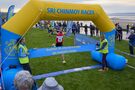
On Sunday 5th November 2006 the Sri Chinmoy Marathon Team held inaugural 50km and a 100km ultra-marathon events in Hagley Park North, Christchurch.
The races were open to both individuals and teams and had a 12 hour cut off.
As with all of the Self-Transcendence races the aim was be to challenge yourself and compete with your own capacities and previous achievements.
What is an Ultra Marathon?
A marathon is 26 miles 385 yards long. An ultra-marathon is any event longer. Typically, 30 miles, 50km, 50 miles, 100km and 100 miles. There are other distances, but those are the most popular. There are also timed events: 12 hours, 24 hours, 48 hours, and multi day-races.
Why do an Ultra Marathon?
For some it's the challenge of going further and longer. For others it's the challenge discovering personal limits, then breaking them. And others have mastered the marathon and are interested in bigger more challenging events.
Marathons are the "ultimate" goal for many runners. But there's a core group of runners that believe the marathon isn't long enough; not enough of a challenge. They feel the need to go longer, sometimes A LOT LONGER! These are different runners, not your average 10 K weekend racer. And although they can be competitive, the camaraderie of ultra-marathoners is legendary. The support for fellow runners during an ultra extends further than any other running event.
Whatever your reason for embarking on this gruelling challenge.you're certain to learn two things about yourself:
1) Your level of commitment to running
2) Your personal limits.both mental and physical
In 2001 NZUA President, Richard Tout, asked Barney McBryde if he would contribute an article to the NZUA News on what he had been up to over the previous few months. Barney had been very active in a number of Ultra events that year, and his response was published in the next issue.
"There are only three winners:
The one who competes with himself.
The one who crosses the finish line first
And the one who finishes the race."
Sri Chinmoy
At 6am on the Sunday of the New Zealand National Championship 24-hour race I did what I had never done before in a race - I quit. The chances of being a winner had just decreased a lot: I certainly wasn't going to cross the line first. . . and I wasn't going to finish the race either. I sat gloomily beside the heater in the lap-counter's tent nursing my right knee.
It had been a great race. . . until 3am. But then it had been a great year.
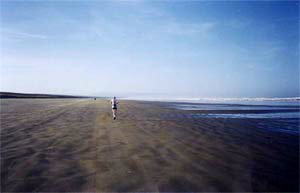
It began on the sands of Ninety Mile Beach; the perfect setting. Any ultra is about leaving everything behind and standing alone before the pride of impossible distance. On the Te Houtaewa Challenge- a 60km race along Ninety Mile Beach- there is only the sky, the sea, the sand and nothing else, and all merge on the horizon over which one must run. A tiny dot resolves itself out of the distance and slowly, ever so slowly draws imperceptibly closer until slowly, slowly it becomes some old Maori woman standing alone with a milkbottle full of water and an old china cup. She pours you some water and hands it to you and takes back the cup with a silent smile when you are satisfied. My mother sometimes ends her letters"aroha nui" (big love)- now I know what she means.
The great moments in ultra running for me are all like that- not the heroic dash across the line (perhaps because mine are never heroic) but rather the girl with the daffodils on the aid station in the Rotorua 100km, Catherine Patton's words of encouragement in the race at Owairaka in 1997, the spirit that one feels at any race, the privilege of racing with legendary runners.
And who is more legendary than Ted Corbitt? 2001 was the year, after six years of running, I finally plucked up courage to do a multi-day race. So I lined up at the start of the Self Transcendence Six Day Race in New York. Amongst the 40 competitors was one who stood out- Ted Corbitt, aged 82.
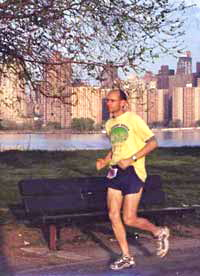
I really only saw Ted's face for the first time at the award ceremony at the end of the race. This was for two reasons. Firstly, because he completed his record-breaking 303 miles hunched forward and leaning to one side, his eyes apparently fixed on the road unfolding before him. Secondly, one only really ever sees the backs of one's fellow competitors. I must confess that although for the majority of the six days of the race I saw his back as I passed him; come Day 6, I saw his back several times as he passed me and disappeared off down the track. To be lapped on a mile loop by a man old enough to be my grandfather- take my age, double it and add ten years- was actually a great honour when that man was Ted Corbitt. At the award ceremony he stood there, his ancient, wise face calm and serene beneath its victor's leafy crown and never said a word as people praised him, applauded him, as the race's creator- in a gesture honouring the man who had so honoured the race by his presence- lifted him overhead with one arm on a special apparatus. What need did he have for words- he had walked the walk, there was no need to talk the talk? If this man is ˜the Father of Ultra Running', as they call him, then this bodes well for the future of ˜his children'. Ultra-running will remain in the pure upper-reaches of the quest for human transcendence.
Musing by my heater at the 24hr race at 6.30am, word came that Jason Holley was back at the track and insisting that I come over to the massage area, that he was going to cure me, and that I was going to carry on with the race. I went, he did, and I did. I missed the distance I had been aiming for, I missed out on reaching 1,000km in races for the year which I had also been hoping for... but I finished the race!- I was a winner!
The fact is that we are all winners in every way.
"You have only one right place
To keep your victory trophy,
And that place is
Your heart's gratitude room"
Sri Chinmoy
There is a lot to be grateful for.
Dhiraja McBryde
Few people look forward to an ultra race. Even fewer positively relish the chance to have ten days of nothing but! Meet one in a million - the indefatigable Niribili File.
Wards Island, New York, 29 April- 9 May 1999, Aucklander Niribili File completes her first 10-day Race.
Yippee! 10 whole days with nothing to do but run- and meditate. The mundane matters of life would be handled by my helper, Eta Field of Christchurch, and she was a tireless worker for the cause.
That was my feeling as I lined up with 7 others at the start of the 10-day race. I confess to a slight nervousness also, conscious of my inexperience. It was my first 10 day, and I was a latecomer to running (started at age 49).
We set off at noon in perfect, mild, spring weather around the 1-mile loop road, winding through the attractive tree-dotted park alongside the river separating Manhattan from Wards Island. The view of the Manhattan skyline, particularly at night, was spectacular- a blaze of light, a view one never tired of. Overhead at one end of the road was a huge motorway bridge which we passed underneath each time around.
On the third day, it seemed that half of New York had descended on our park for picnics, and it was a case of dodging people, noisy motorbikes, and the buggies, roaring up and down until the police got them. Day 5 saw our 14 comrades in the 6-day race joining in, and light rain falling. In the two races combined, 14 different countries were represented.
Overall, the weather was excellent- mild and calm. This, combined with a happy and encouraging atmosphere generated by the Sri Chinmoy Marathon Team organisers, volunteers and supporters, made for most enjoyable running conditions.
The style of the race is"go as you please", which means no timetable. My schedule was simple: sleep from 11pm to 2am, emerge from my tent at 2:30am and (hopefully) keep going, with a snooze after lunch. Two or three counters were on duty in shifts around the clock and food was available at all hours.
The little cluster of custom-made buildings comprising the"camp" are specially erected each year just for the race, taking a week of voluntary work to put up. Dormitories are provided but most runners and helpers prefer to bring their own tents.
But all was not fine and dandy, and I developed shin splints on Day 2. It took massages (ouch), lots of walking and double doses of painkillers over two days for the condition to ease enough to allow running. There was also the unusual remedy of cabbage leaves with ice packs wrapped around the leg.
After three or four days of (yahoo) running again, blow me down- that old shin splint returned with a vengeance. After yet another trip to medical- at least I gave them something to do- I resigned myself to the inevitable and walked the last three days.
In order to achieve a 50 mile per day average, I cut down on rest and on the last night I walked through until closeoff at noon next day. There was a bad patch or two that night, but the reward was a lovely pink sunrise next morning.
Sometimes a mile would take half an hour, but at least I was putting one foot in front of the other. I can't remember a lot of smiles at that stage of things.
Shortly before"time'sup" on Day 10, my goal of 500 miles was realised and I passed by the counters in a fatigued and slightly disoriented state, whereupon someone from the medical tent carted me off for repair work to my ever increasing crop of blisters.
The race gave me the opportunity to test and transcend my inner strength and my physical endurance level. Afterwards the pain was quickly forgotten, but the satisfaction of completing the race remained. I was still in one piece, albeit minus three toenails and 5kg of weight.
I think I have caught the multiday bug.
~~~~~~~~~~~~~~~~~~~~~~~~~~~~~~~~
Sri Chinmoy has been an avid athlete all his life and an advocate of the benefits of fitness. The following is a chronicle of Sri Chinmoy's own remarkable athletic endeavours.
This section of the site also contains photographs and events of Sri Chinmoy's sprinting, distance running and weightlifting career.
Weightlifting
Lifting Up the World with a Oneness-Heart
Sri Chinmoy has lifted almost 8,000 individuals from all walks of life overhead with one arm to honour them for their contributions to society.
| 30 Jan 1987 | 70633/4-lb One-arm Lift (right arm) |
| 04 Aug 1988 | 7040-lb One-arm Lift (left arm) |
| 12 Apr 2004 | 10 reps of 400-lb Crunch Abdomen-Ups |
| 19 Feb 2000 | Standing Overhead Double Dumbbell Lift, 1300 lbs |
| 15 Oct 2000 | 1,000-lb Double Dumbbell Bench Press |
| 12 Apr 2004 | 800-lb Seated Overhead Double Dumbbell Lift |
| 11 Apr 2004 |
Lifted 146,931 lbs in one day – a record number, 20,000 lbs or 10 tons more than he did at his 2002 public weightlifting exhibition |
| 11 April 2004 |
Lifted own body weight of 177 lbs (including apparatus) 100 times with his left arm from a seated position, 1 minute, 17 seconds |
| 28 Nov-6 Dec 2002 | Lifted 1,000 lambs in a Seated Double-Arm Overhead Lift in 6 lifting sessions, New Zealand |
|
10 Dec - 16 Dec 2002 |
Lifted 100 cows in an Overhead Platform Standing Calf Raise Lift in 3 lifting sessions, New Zealand |
More: Sri Chinmoy's Weightlifting »
Rainbow-Dreamers
In 1996 and 1997 Sri Chinmoy embarked on a wide range of personal challenges.
| 21 Apr 1996 | Standing Vertical Jump, 181/4” |
| 03 May 1996 | Standing High Jump, 35” |
| 16 Jun 1996 | Vertical Jump onto a Platform, 33” |
| 22 Feb 1997 | 79 baskets out of 100 from foul line |
Rainbow-Dreamers Bodybuilding Exercises
| 30 Apr 1996 | Step-Ups Wearing a Weighted Vest, 100 step-ups with 50-lb vest |
| 16 Jun 1996 | Walking with a 100-lb Weighted Vest, 250 metres |
| 17 Aug 1996 | Crunch Sit-Ups, 13,000 in 2 hours, 40 minutes |
Athletics
Personal Bests, Sprinting to Ultramarathons
Sri Chinmoy has completed 241 races, including 22 marathons and 5 ultramarathons
| 11 Jul 1992 | 100m 13.67 seconds Sri Chinmoy Masters Games, Queens, NY |
| 11 Jul 1992 | 200m 29.69 seconds Sri Chinmoy Masters Games, Queens, NY |
| 27 Sep 1983 | 400m 72.66 seconds World Masters Games, San Juan, PR |
| 29 Jul 1981 | 800m 2:47 Sri Chinmoy Grand Prix, Queens, NY |
| 27 Jun 1982 | 1500m 6:30 Sri Chinmoy Race, Queens, NY |
| 02 Aug 1981 | 1 mile 6:23 Sri Chinmoy Grand Prix, Queens, NY |
| 29 Mar 1981 | 2 miles 13:42 (6:51 pace) Sri Chinmoy Race, Westport, CT |
| 06 Jun 1979 | 3 miles 22:21 (7:27 pace) Sri Chinmoy Race, Scottsdale, AZ |
| 17 May 1980 | 3.1 miles/5k 22:12 (7:09 pace) Great North Fork Footrace, Greenport, NY |
| 23 Mar 1980 | 3.5 miles 25:29 (7:09 pace) March Speed Run, Brooklyn, NY |
| 07 Aug 1982 | 4 miles* 30:33 (7:34 pace) Summer Blahs Race, Central Park, NY, NY |
| 11 July 1982 | 5 miles* 38:11 (7:38 pace) Sri Chinmoy Race, Queens, NY |
| 10 Oct 1981 | 6.2 miles/10k* 54:11 (8:48 pace) Foliage Run, Ringwood, NJ |
| 30 Mar 1980 | 7 miles 51:18 (7:19 pace) Sri Chinmoy Race, Fairfield, CT |
| 23 Sep 1979 | 10 miles 1:23:47 (8:23 pace) Sri Chinmoy Race, Greenwich, CT |
| 13 Sep 1981 | 13 miles* 2:01:30 (9:20 pace) Sri Chinmoy Marathon (first 13 miles), Plainsboro, NJ |
| 15 Nov 1981 | 13.1 miles* 1:55:24 (8:48 pace) Sri Chinmoy Half-Marathon, Queens, NY |
| 04 Oct 1981 | 15.5 miles/25k 2:30:35 (9:43 pace) New York City Marathon Tune-Up, Central Park, NY, NY |
| 25 Mar 1979 | 26.2 miles 3:55:07 (8:58 pace) Heart-Watchers Marathon, Toledo, OH |
| 27 Aug 1980 | 47 miles 11:27:24 Sri Chinmoy Ultramarathon, Queens, NY |
*The following are unofficial split times that surpass the above race times
27 Jul 1982 4 miles 30:21 Rhode Island
27 Jul 1982 5 miles 38:07 Rhode Island
27 Jul 1982 6.2 miles/10k 47:11 Rhode Island
02 May 1982 13 miles 1:54:04 Newsday L.I. Marathon, Long Island, NY
02 May 1982 13.1 miles 1:54:30 Newsday L.I. Marathon, Long Island, NY
More: Sri Chinmoy's Sprinting »
Sri Chinmoy's Distance Running »
Tennis
| 13 Jun 1977 | Sri Chinmoy started playing tennis |
| 3 Jun 1978 | Sri Chinmoy played 453 games of tennis in 17 hours |
Push-ups
| 07 Jan 1986 | 2,230 in 59 minutes 50 seconds, Kyoto, Japan |
Document Actions


Superfit at 74—Sri Chinmoy’s 203 Lb Pioneering Wrist Curls
Sri Chinmoy breaks his own record by curling a colossal 203 lb. dumbbell...
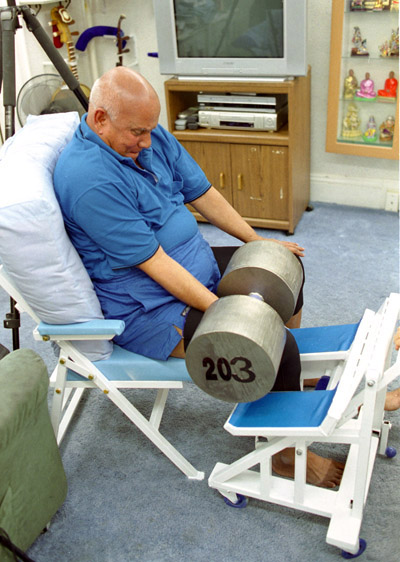
203lb dumbell lift in the lifted postion.
Just one week after curling more than any one else in the world, world fitness champion and international harmony leader Sri Chinmoy (“SHREE CHIN-MOY”), now 74 years old, broke his own record by curling a colossal 203 lb. dumbbell ten times with his right wrist and then ten times with his left wrist. Concentrated in this mega-dumbbell is a weight which is 23 pounds over Sri Chinmoy’s own bodyweight. This is the New Yorker’s top weight with this lift.
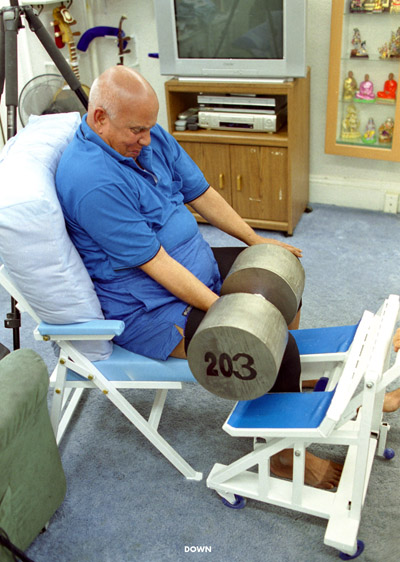
203lb dumbell lift in the lifted postion.
Sri Chinmoy states:
“You may wonder why I do such stupid things at the ripe old age of 74! My Inner Pilot, God, is my Inspiration. He is my Aspiration. He is my Protector. I give Him all the credit.”
Asked about his message to others, Sri Chinmoy says,
“Never give up! Never give up! Physical fitness is of paramount importance. There is no age limit when we live in the heart and when we try to be of prayerful and soulful service to God in the heart of humanity.”
The dumbbell is so heavy that it takes two adult assistants just to place the weight on a cradle which is then lowered near Sri Chinmoy’s quadriceps. After the cradle is completely separated and far out of the way, he curls the entire weight with only his wrist muscles. Because the weight is so heavy, Sri Chinmoy feels that he is taking a great risk with the 200 pound dumbbell. In the future, he will practise on a regular basis with 170 lbs.
Jim Smith, long-time Registrar of the British Amateur Weight Lifters Association and an expert on lifting heavy weights exclaimed:
“I am certain that nobody else in the world can do a wrist curl with a 200 pound dumbbell—no matter how old they are or how much they weigh! The strongest men in the world are seeing that a septuagenarian is curing with one arm much more than twice the weight that the world’s best bodybuilders and weightlifters can curl with two arms.”
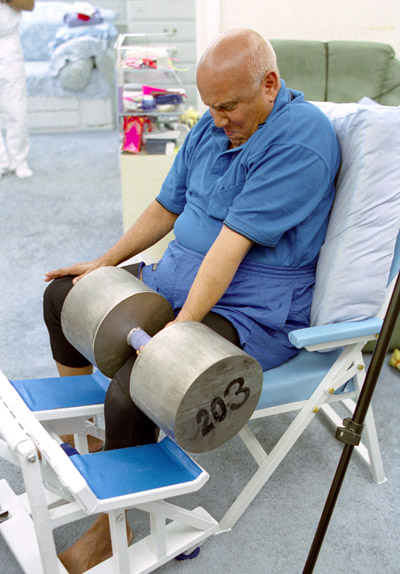
203lb dumbell lift in the down postion.
Five-time Mr. Universe Bill Pearl and holder of the “Best Built Man of the 20th Century” title stated:
“In my more than 60 years in the fitness and bodybuilding field I have never heard of anyone in the world able to curl this huge amount of weight! This is a miracle to me!”
Sri Chinmoy is also known and highly respected internationally for his many activities to foster world harmony, including the World Harmony Run and global humanitarian service.
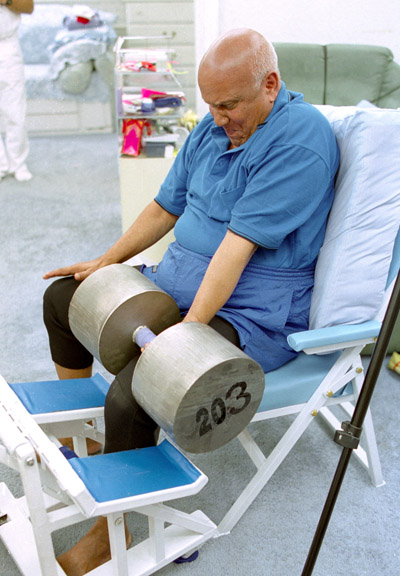
203lb dumbell lift in the lifted postion.
Bodybuilding’s top magazine, Muscle and Fitness, awarded Sri Chinmoy the second greatest feat of strength for any human being in the past year—lifting 200,873 pounds of weight in one evening at a New York event.
International fitness champion and global harmony leader, 74-year-old Sri Chinmoy, has curled a mammoth 256 pound dumbbell with each wrist—by far the heaviest dumbbell ever curled—and he did it 10 times with each hand! Using only the very small wrist muscles, Sri Chinmoy has curled a weight 76 pounds over his own bodyweight.
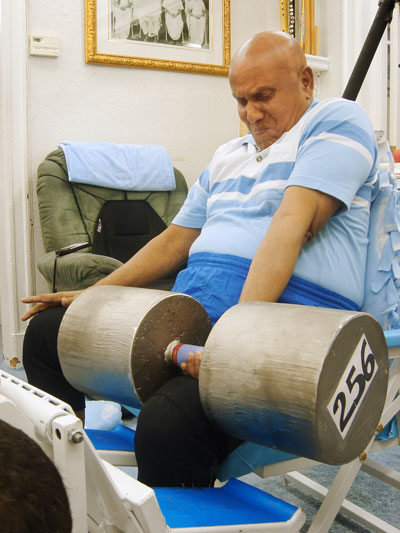
With his weightlifting Sri Chinmoy hopes to inspire people of all ages with a philosophy of “never give up!” Top strength athletes and fitness experts are astounded at the senior citizen’s herculean achievement. Five-time Mr. Universe and ‘Best Built Man of the Century’ Bill Pearl exclaimed:
“In my more than 60 years in the fitness and bodybuilding field, I have never heard of anyone in the world able to curl this huge amount of weight! This is a miracle!”
In just 3 weeks’ time, Sri Chinmoy has added more than 50 pounds to his own world record. Renowned as an author, musician and artist, Sri Chinmoy explains his meteoric lifting progress and world record success very simply:
“God out of His infinite Bounty has given me the capacity to do this 256 pound wrist curl with each hand. I am placing my happiness-heart- achievement at the Feet of God.”
* * *
Other Comments on Sri Chinmoy’s Wrist Curls
(From his 203 lb wrist curls)
Wayne DeMilia, Head Judge, Mr. Olympia Contest
Chairman, International Federation of Body Builders
“Out of all the weightlifters and champion bodybuilders I have seen, and I have seen many, Sri Chinmoy is the only one I have ever seen wrist curl a 200 lb. dumbbell.”
Jim Smith, long-time Registrar, British Amateur Weight Lifters Association
“I am certain that nobody else in the world can do a wrist curl with a 200 pound dumbbell—no matter how old they are or how much they weigh! The strongest men in the world are seeing that a 70-year-old man is curling with one arm much more than twice the weight that the world’s best bodybuilders and weightlifters can curl with two arms.”
Question: I find that sometimes I go through a period of making very good progress in sport; and then after some time everything falls apart and my training goes downhill.
Sri Chinmoy: It happens to everyone. Life is not always smooth sailing; it goes up and down. The main thing is to get satisfaction. In sport, when you touch a peak you are very happy. When you are unable to reach your peak, you should not feel that it is your fault. It is not that you have deliberately injured yourself. You have not said to your body, "I fed you so many times; now I want to starve you." If you are deliberately enjoying your lack of speed or lack of enthusiasm, then you are to be blamed. But if circumstances have led you to this condition, please try to maintain your equanimity and peace of mind. Feel that you are going through a phase that may last for three or four weeks, but that eventually it will pass. Try to think of the summit which you reached two or three weeks earlier, and try to remember the joy that you felt. Then you will see that the joy you got from your previous achievements will carry you through, and very soon you will not only reach but transcend your previous height. You are not fooling yourself; you are only bringing happiness into your system, and this happiness is confidence. Again, confidence itself is happiness.
Try to feel that your problem is just a small obstacle, a hurdle that you will soon overcome. Then you will be able to diminish the frustration that you now feel. Once you diminish your frustration, again in a week or so you will be able to regain your capacity. But if you maintain or increase your frustration, then the problem will linger. It may go on for two or three weeks.
Question: Always when I become very interested in the physical and playing sports, I injure myself to the point where I have to stop completely. Why does this happen?
Sri Chinmoy: What actually happens in your case is that when you enter into the physical world - playing tennis or other things - you do not give value to the physical as such. You remain in the mind. A portion of your existence you throw into the game and another portion you keep totally in the mind-world. It is like cutting yourself in half. You are keeping your body on the first floor, but your consciousness is always on the upper floor, in the mind. If you can direct more of your mental energy into the physical when you play, this will not happen. You want to play; you want to win. But actually the concentration of the mind, the real concentration, is not in the physical itself. You know that you are playing tennis, but the concentration that the body needs from the mind is not there. There is a gap. The body without concentration from the mind is helpless. So, when you play, do not think of your mental work. Your mind may not be aware that it is thinking of the wrong thing, but it is one thing not to be aware of doing the wrong thing and another thing to concentrate consciously on the right thing. Inside you and all around you there are many beings. Because there is a gap between the mind's concentration and the physical activity, these beings can attack the physical. They need not actually be wrong forces, but they may create unfortunate experiences in life.
Question: How can running help me overcome my spiritual weaknesses and impurities?
Sri Chinmoy: While you are running - especially when you are tired - you are much more conscious of your breathing. You are more aware of when you are inhaling and when you are exhaling. While running, when you inhale, you can consciously invoke divine energy to energize you. This divine energy energizes the willing reality in you and illumines the unlit reality in you so that you can become a perfect instrument of God. When you breathe in the divine energy, automatically it changes or transforms undivine forces into divine forces.
Each time you breathe in, if you can repeat just one time God's Name, or 'Supreme', or whatever divine name or form comes to mind, then that spiritual thought will increase your purity. Either it turns into purity within you or it grants purity to you. Then, when you breathe out, feel that a new eagerness and a new promise are going out from you to the Universal Consciousness. This new promise is nothing short of your sincere willingness and eagerness to become a good and perfect instrument of the Supreme.
Question: Should we run even when we are extremely tired?
Sri Chinmoy: As a rule, when we are extremely tired it is not advisable to run, for it will not help us in any way. At that time, running will be nothing but fatigue and self-destruction, and it will leave in our mind a bitter taste. But sometimes, even when we are not extremely tired, we feel that we are. At that time we are not actually physically tired. We are only mentally tired or emotionally tired, but the mind convinces us that we are physically tired. Our human lethargy is so clever! It acts like a rogue, a perfect rogue, and we get tremendous joy by offering compassion to our body. We make all kinds of justifications for the body's lethargy and make ourselves feel that the body deserves rest.
So we have to be sincere to ourselves. If we really feel extremely tired, then we should not run. But we have to make sure that it is not our lethargic mind, our lethargic vital or our lethargic physical consciousness that is making us feel that we are extremely tired. This kind of tricky cleverness we have to conquer.
With our imagination-power we can challenge the tricky mind and win. We weaken ourselves by imagining that we are weak. Again, we can strengthen ourselves by imagining that we are strong. Our imagination often compels us to think we cannot do something or cannot say something. We often use imagination in a wrong direction. So instead of letting imagination take us backwards, we should use it to take us forward toward our goal.
Question: How do you run through inner pain?
Sri Chinmoy: Inner pain is a joke. Outer pain I believe in. Sometimes I can't place my foot on the ground without getting such pain! But inner pain, which comes from frustration, depression, jealousy and insecurity, is a joke. Inner pain should be discarded like a filthy rag! Outer pain you cannot so easily ignore, but inner pain must be discarded.
If you have inner pain, if you are jealous of someone or are in an undivine consciousness, then the outer running will actually help you. When you are running and perspiring, when you are struggling, at that time the inner pain goes away to some extent. Otherwise, if because you are depressed you don't go out to run, then you are just a fool. If you feel depressed while you are running, you can sing loudly and deliberately try to sing wrong notes. Then laugh at yourself. Some of my friends used to do this. They were good singers, but deliberately they would sing wrong notes while they were walking, and it would make them laugh. In that way they got rid of depression.
Question: If one is in generally good health, what would cause pain and aches in the body?
Sri Chinmoy: It is one thing to have good health and another thing to deliberately maintain good health. Unless you are consciously keeping good health, at any moment you may be attacked by some forces. It is like having a large amount of money without knowing about it. If you are not conscious of it, you may easily lose it. If you are not conscious that you have a flower, you are likely to lose it. Anything that you have must have some place in your awareness. You may have good physical health, but perhaps in two months' time you have not thought of your body once, let alone tried to increase the strength of your legs or arms or to get some extra capacity.
Unless you touch something every day, it does not shine. Often I have told people to touch the furniture in their homes every day. As soon as you touch something, it gets new life. If you are aware of something, immediately it shines and gets a new luminosity. If you have good health, if you touch your health every day, it gets new life. By giving attention to something, you give new life to it.
Question: When I run I sometimes get a slight knee pain. Should I stop running at that time?
Sri Chinmoy: If you get just a slight pain in your knee, and if the pain is bearable, then you should continue running. At that time, feel that if you run a hundred metres more, the pain will go away. Then, after you have covered a hundred metres, feel that the pain will definitely stop if you run another hundred metres. If you do this five or six times, then most of the pain will go away. Even if some pain remains, the mind has already taken away your awareness from it. Your mind has forgotten about it. But if the pain is absolutely unbearable, what can you do? You simply have to surrender to it and stop running, at least for a while.
Question: How can we spiritually heal injuries?
Sri Chinmoy: It is a matter of inner capacity. One kind of capacity is to heal the injury by bringing down peace and light from above. Another kind of capacity is to ignore the pain altogether. During your meditation, if all of a sudden you have intense aspiration, then you can bring down more light from above to cure your injury. But you have to do this consciously during your meditation. If during the day you casually say, "Oh, how I wish I didn't have any pain!" that will be useless. But while you are meditating, if you suddenly remember your pain, that is the time to pray and bring down more light.
Again, you can increase your capacity to tolerate pain. Now you have pain, let us say, but still you run; whereas if you had had the same kind of pain four years ago perhaps you would not have been able to run. Again, sometimes the pain is unbearable and it is absolutely impossible to run. Then what can you do? But if it is bearable, try to run according to your own capacity. At that time, don't think of how fast this person or that person is running. Just go according to your own capacity and remain cheerful. All the time think that you are running only against yourself. Again, if it is beyond your capacity to ignore the pain, in addition to praying and meditating, you can also go to the outer doctor. Light is also inside the doctor.
Question: Sometimes I feel pain in my foot, and I start worrying that if I keep running, I might get a stress fracture. This happens even if the pain is not that bad and I know that probably nothing will happen.
Sri Chinmoy: If it is unbearable, excruciating pain, then something serious might happen. But if there is just a tiny pain in your foot, this kind of fear is only false anxiety that is coming to your mind. If you are worried, you can take rest for a few days and see if the pain goes away. If it leaves in just a day or two, you will know that it was nothing serious. In this way you will become more confident that nothing will happen to your foot if you run.
So if the pain is not that serious, you do not have to worry. Your foot is not going to give out. It is only that fear has entered into your mind, and the mind has created false anxiety in you, a false alarm. You should not cherish these fears.
Morning running is purity's beauty. Evening running is simplicity's luminosity.
Don't take a late start. You may lose the race altogether. Keep your love-devotion-surrender Always on the alert. Then you cannot have a late start.
Run! You can easily challenge The pride of frightening distance.
Question: If your goal is to run fifty miles per week, is it better to run seven miles a day or to vary the distance?
Sri Chinmoy: It is always good to have easy and hard days. It is best to have two easy days and then one hard day. Even having alternate easy and hard days is not good enough. If you run fifteen miles one day, it is not good to run seven or ten miles the next day. Instead, on your hard days cover twenty or twenty-five miles or even a full marathon. Then take two easy days. In this way, you can cover seventy or eighty miles a week.
Only those who are very strong and who are seriously training for long-distance running should do more than seventy miles a week. They can run one hundred miles or one hundred twenty miles.
Question: How much importance should we give to physical exercise in comparison to our regular work?
Sri Chinmoy: You are working very hard at your business, but you are thinking that that is the only work you have to do. You are giving one hundred per cent of your attention to your business and not even one per cent to your body. You have to feel that the body is also something necessary. So when you are here taking exercise or practising sports, you have to think that this is the only thing in your life. Otherwise, while you are practising sports you will still be thinking of your business. If you give importance to sport, you will get extra energy from it for your work.
Question: How do you feel about bicycle training to improve running?
Sri Chinmoy: I did a great deal of bicycling when I lived in India in my youth. For at least two and a half hours every day I used to cycle as I did errands. It does not increase running speed at all, but something is better than nothing. Sometimes cycling can actually be a hindrance to running speed, because it develops special kinds of muscles which do not complement the speed muscles. Bicycling does help for endurance, but if you want to increase your running speed, then I don't advise it. You can cycle for endurance, or if you are injured and cannot run. For a little bit of stamina you can do it. But again, cycling stamina is totally different from running stamina. If one wants to become a good runner and maintain a five-minute pace, then cycling is not the answer. Quality road work is the answer.
Question: What is a good exercise to strengthen the legs when they get tired from standing all day?
Sri Chinmoy: If your legs get tired from standing all day, there are two exercises that are very good to strengthen them. One exercise develops the knee muscles. You sit on the floor with one leg straight, and the other leg bent with the knee up, both hands on your hips. Then you switch, bending the straight leg and straightening the bent leg. Then keep switching.
The other exercise is to do a deep knee bend on one leg, with the other leg out in front of you, and then stand up again, still keeping one leg in front of you. First you do it with a flat foot, then on your toe. If you can do it three or four times, your legs will have tremendous strength from top to bottom.
Question: Do people really need more sleep when they are training for athletics?
Sri Chinmoy: For ordinary people, it is true. If they run a few miles, they need more sleep. But for spiritual people, especially advanced seekers, it is not necessary. By drawing down cosmic energy, in two minutes they can get the rest of two hours, three hours, four hours. It depends on how effectively you can draw in cosmic energy. But ordinary runners do have to sleep longer.
Question: What time of day is best to run?
Sri Chinmoy: It depends on the individual runner. Whenever the individual feels most physically fit, most vitally fit, most mentally fit and most psychically fit is the best time for that individual to run.
Running makes the body young. Striving makes the vital young. Smiling makes the mind young. Serving makes the heart young. Loving makes the soul young.
- ‹ previous
- 19 of 21
- next ›